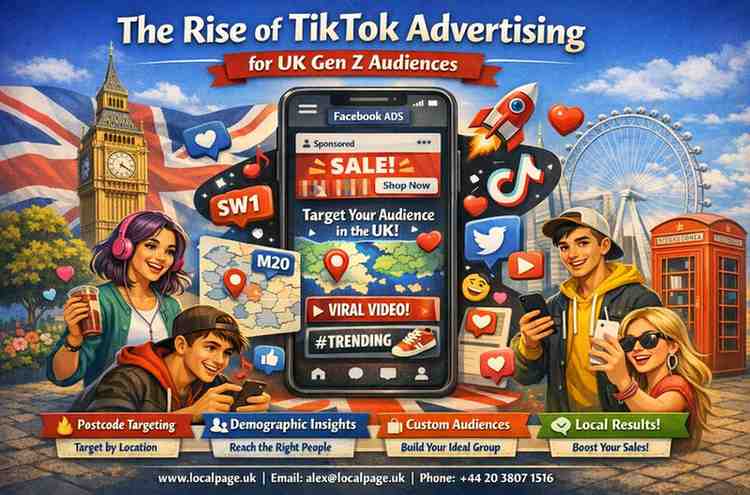
The rise of TikTok advertising for UK Gen Z audiences
Gen Z in the UK now spends more time on TikTok than any other social platform. For businesses trying to reach consumers aged 16 to 27, this shift represents both an enormous opportunity and a genuine challenge. The brands winning attention in 2026 are not those repurposing Facebook campaigns or recycling television scripts — they are the ones creating content that feels native to the platform. Understanding how to reach this audience through TikTok is rapidly becoming one of the most important skills in business advertising UK, and the window for early advantage is narrowing fast.
Why TikTok Is Redefining How UK Brands Reach Gen Z
The numbers tell a clear story. Over 17 million people in the UK use TikTok monthly, and roughly 60% of those users fall within the 16 to 27 age bracket. This is not a passive audience either. Gen Z users on TikTok engage, comment, share, and — critically for advertisers — purchase. Research from 2025 showed that 42% of UK Gen Z consumers had bought a product directly after seeing it on TikTok, surpassing both Instagram and YouTube for purchase influence in this demographic.
What makes TikTok fundamentally different from other platforms is its content discovery engine. Unlike Facebook or Instagram, where users primarily see content from people they follow, TikTok’s For You Page serves content based on behavioural signals: watch time, rewatches, shares, and interaction patterns. This means a brand with zero followers can reach millions of relevant users if their content resonates. The playing field is genuinely level in a way that no other major platform offers.
For UK businesses, this is particularly significant because traditional advertising channels — television, radio, print, even Facebook — are losing reach with younger audiences at pace. A university in Manchester trying to attract clearing applicants, a fashion retailer in Birmingham aiming at student shoppers, or a fitness brand in London targeting young professionals cannot rely on channels that Gen Z simply does not use. TikTok is where this audience lives, and any strategy for online business advertising UK that ignores it is inherently incomplete.
Do not think of TikTok as a social network. Think of it as an entertainment platform that happens to have social features. Content that educates, entertains, or surprises will always outperform content that simply promotes. The best TikTok adverts do not feel like adverts at all.
Understanding the UK Gen Z Audience on TikTok
Effective advertising requires deep audience understanding, and UK Gen Z has distinct characteristics that set them apart from older demographics and from Gen Z in other markets. Failing to understand these nuances is one of the primary reasons that brands — including large, well-resourced ones — stumble on TikTok.
Authenticity Over Production Value
UK Gen Z has an almost allergic reaction to overtly polished content. A professionally shot, scripted television-style advert performs noticeably worse than a smartphone video filmed in a stockroom by a genuine staff member. This preference for authenticity is not a trend — it is a permanent shift in how this generation evaluates brands. They have grown up surrounded by advertising and have developed sophisticated filters for detecting insincerity.
Values-Driven Purchasing
Environmental responsibility, diversity, mental health awareness, and ethical sourcing are not optional messaging for this audience — they are baseline expectations. A fashion brand that promotes fast fashion without acknowledging sustainability will face immediate scepticism. A food brand that uses inclusive casting and discusses supply chain transparency will earn attention and trust. These are not marketing tactics; they are genuine values that Gen Z uses to filter which brands deserve their money.
Micro-Community Belonging
UK Gen Z does not gather around mass-market content. They cluster in micro-communities: “BookTok” for readers, “CleanTok” for cleaning enthusiasts, “FitTok” for fitness, “FoodTok” for cooking, “StudyTok” for students. Each community has its own language, norms, and content expectations. A successful campaign does not target “Gen Z” as a monolith — it targets specific communities within that demographic.
The most effective UK TikTok campaigns in 2026 are community-specific. A skincare brand does not target “skincare enthusiasts” — it targets “Barrier Repair TikTok” or “Slugging TikTok.” Granularity wins. The brands that try to appeal to everyone on TikTok appeal to no one.
Traditional vs Modern Advertising: The UK Generational Divide
The shift from traditional to modern advertising in the UK is not happening gradually — it is accelerating, and TikTok is a primary catalyst. Understanding this divide matters because many UK businesses are still allocating the majority of their budgets to channels that their target audience has effectively abandoned.
What Traditional Advertising Still Does Well
It would be inaccurate to dismiss traditional channels entirely. Television advertising still reaches mass audiences, particularly older demographics. Local radio remains effective for trades and services targeting homeowners aged 35 and above. Print advertising in local newspapers can still generate enquiries for businesses serving rural communities where digital adoption is slower. The question is not whether these channels work — it is whether they work for your specific audience and objective.
Where Modern Digital Advertising Wins for Gen Z
For the 16 to 27 demographic, digital platforms deliver advantages that traditional media simply cannot match. Precise targeting, real-time performance data, lower entry costs, and the ability to iterate campaigns based on live results make digital advertising fundamentally more efficient. A TikTok campaign targeting university students in Newcastle can be launched, measured, and optimised within days. A equivalent television or print campaign requires weeks of planning, significant upfront cost, and delivers no performance data until after the campaign has ended.
The distinction matters enormously for small business advertising UK. A small independent brand in Brighton cannot afford television. But that same brand can produce compelling TikTok content on a smartphone and reach hundreds of thousands of precisely targeted Gen Z consumers for a fraction of the cost. The barrier to entry has collapsed, and the businesses that recognise this first gain a disproportionate advantage.
Assuming that what works on Facebook or Instagram will work on TikTok. The audiences, content formats, and algorithmic behaviour are fundamentally different. Repurposing content without adaptation is the single most common reason UK businesses fail on TikTok.
Cost Breakdown: TikTok Advertising for UK Businesses
Budget planning requires realistic benchmarks. TikTok advertising costs in the UK have stabilised as the platform has matured, but they remain competitive compared to Facebook and Instagram for Gen Z reach. The following figures represent current 2026 averages for business advertising packages UK that include TikTok as a channel.
Cost Per Thousand Impressions (CPM) by Format
- In-feed video ads: £4–£8 CPM
- TopView (full-screen takeover): £15–£25 CPM
- Spark Ads (boosting organic content): £3–£6 CPM
- Branded Hashtag Challenges: £50,000–£150,000 flat fee (typically for larger brands)
Cost Per Click and Cost Per Lead Benchmarks
For UK campaigns targeting Gen Z, average cost per click ranges from £0.40 to £1.20 depending on industry and creative quality. Cost per lead varies more significantly: fashion and beauty brands typically see £3–£8 per lead, whilst higher-consideration purchases like technology or education can range from £10–£25 per lead. These costs compare favourably to Facebook, where Gen Z targeting CPMs have risen steadily as competition for this audience has increased.
Budget Recommendations
Businesses new to TikTok should plan a minimum test budget of £500–£1,000 for the first month. This allows for meaningful creative testing across at least three to four variations. Established brands investing seriously in Gen Z acquisition should budget £2,000–£5,000 monthly, with the understanding that TikTok rewards consistent presence over sporadic bursts. The platform’s algorithm favours accounts that post regularly, and this applies to paid content as much as organic.
affordable business advertising UK — explore fixed-price listing packages designed to complement your TikTok campaigns with sustained local visibility across UK cities.
GEO Targeting: Reaching UK Cities Through TikTok
Geographic targeting on TikTok has improved substantially since the platform’s early days. In 2026, UK advertisers can target by country, region, city, and postcode area — although postcode targeting on TikTok remains less granular than Facebook’s district-level capability. For most Gen Z campaigns, city and regional targeting is sufficient because young consumers cluster in urban and university-town locations.
High-Value UK Cities for Gen Z TikTok Campaigns
London, Manchester, Birmingham, Leeds, Bristol, Glasgow, Edinburgh, Nottingham, Liverpool, and Sheffield represent the highest-concentration Gen Z markets in the UK. Each city has distinct cultural characteristics that should inform creative approach. A campaign targeting Manchester students will resonate with different references, humour, and aesthetic preferences than one targeting Bristol or Glasgow. Generic national campaigns consistently underperform against locally adapted creative.
University Town Targeting
Beyond the major cities, university towns represent concentrated Gen Z populations that are highly valuable for certain sectors. Durham, Exeter, St Andrews, York, Bath, and Warwick each host thousands of students with specific needs: accommodation, food delivery, fashion, entertainment, and career services. TikTok allows advertisers to target these towns specifically, creating campaigns that feel locally relevant rather than nationally generic.
Regional Language and Cultural Nuance
The UK is not a single cultural market. References that land in London may confuse or alienate users in Glasgow. Humour that works in Manchester might fall flat in Bristol. The most effective geo-targeted campaigns adapt creative for each region, even when the underlying product and offer remain the same. This does not necessarily mean producing entirely separate videos — it can mean adjusting on-screen text, voiceover, and music choices to match regional sensibilities.
TikTok is developing live event-based geo-targeting that triggers adverts based on users attending specific concerts, festivals, or sporting events in UK cities. A food brand could serve adverts to users at Glastonbury or TRNSMT Festival in real time, offering location-specific redemption.
Step-by-Step Strategy for UK TikTok Ad Campaigns
A structured approach prevents the most common cause of TikTok advertising failure: jumping straight to content creation without a clear strategy. Follow this framework to build campaigns that reach UK Gen Z audiences effectively and generate measurable results for your business advertising UK investment.
Step One: Define Your Community, Not Your Audience
Instead of saying “we target 18 to 24-year-old women interested in fashion,” identify the specific TikTok community: “We target ‘Vintage Fashion TikTok’ users in London and Manchester.” This shift from demographic to community targeting changes your creative approach entirely and dramatically improves results.
Step Two: Research Existing Content in Your Community
Spend at least two weeks immersing yourself in the community before creating anything. Note the formats that gain traction, the language used, the creators who lead conversations, and the brands that are already present. Identify gaps — topics or formats that are underserved. Your opportunity lies in those gaps.
Step Three: Develop a Content Framework
Create a framework that covers three content types: educational (teaching something useful), entertaining (making people laugh or feel something), and social proof (showing real customers using your product). Aim for a ratio of roughly 40% entertaining, 30% educational, and 30% social proof. Most UK brands over-index on promotional content and under-invest in entertainment.
Step Four: Produce Native-Looking Creative
Use smartphones, not professional cameras. Film vertically, not horizontally. Use trending sounds and formats, not licensed music. Include text overlays because a significant portion of UK TikTok users watch without sound. Keep videos between 15 and 45 seconds for in-feed adverts. The content should look and feel like it belongs on the platform, not like it was imported from another channel.
Step Five: Launch with Spark Ads
Spark Ads allow you to boost existing organic posts that are already performing well. This is lower risk than creating dedicated ad content because you know the content resonates before you spend money on distribution. Post organically, monitor performance for 24 to 48 hours, and boost the posts that gain the most organic traction.
Step Six: Measure, Learn, Iterate
Track views, watch-through rate, shares, profile visits, link clicks, and conversions. The most important metric for TikTok is watch-through rate — if viewers are not watching to the end, your targeting or creative needs adjustment. Iterate weekly during the first month, then move to fortnightly optimisation once patterns emerge.
How to Avoid Common TikTok Advertising Mistakes in the UK
The learning curve on TikTok is steeper than many UK businesses expect. The platform punishes mistakes that would be tolerable on other channels, and the cost of those mistakes is not just wasted budget — it is reputational damage in front of an audience that is highly vocal about inauthenticity.
Mistake One: Corporate Tone in an Informal Space
Using formal language, corporate messaging frameworks, or brand voice guidelines developed for other channels. TikTok users scroll past anything that feels like a press release dressed up as a video. The tone should be conversational, direct, and slightly informal — think “a knowledgeable friend” rather than “a brand representative.” A bank targeting student accounts in Leeds should sound like a helpful older sibling, not a compliance officer.
Mistake Two: Ignoring Sound and Music Trends
Sound is integral to the TikTok experience. Ignoring trending sounds, using royalty-free music that sounds generic, or adding a voiceover that does not match the energy of the video all signal that a brand does not understand the platform. The most successful UK brands on TikTok monitor trending sounds daily and incorporate them into their content within 24 to 48 hours of a sound gaining momentum.
Mistake Three: Treating TikTok as a Direct Response Channel
Expecting immediate, measurable conversions from every TikTok campaign misunderstands how Gen Z discovers and evaluates brands. TikTok is primarily an awareness and consideration channel for this audience. Users may see your content five or six times before visiting your website or making a purchase. Building attribution models that account for this delayed, multi-touch journey is essential for accurate performance evaluation.
Mistake Four: Posting Inconsistently
Brands that post three videos in one week and then disappear for a month perform significantly worse than those posting consistently — even if the sporadic content is higher quality. The TikTok algorithm rewards regular posting, and Gen Z audiences lose interest in brands that are not reliably present. Consistency builds familiarity, and familiarity builds trust.
Running TikTok adverts without an organic content presence. Paid content that lands on a brand page with zero organic posts looks suspicious and reduces trust. Build an organic foundation before investing in paid promotion — even if that foundation is just ten to fifteen well-made videos.
Voice Search Optimisation for UK TikTok Ad Campaigns
Voice search and TikTok advertising may seem unrelated, but they intersect in ways that matter for UK businesses pursuing digital business advertising UK strategies. When a Gen Z user in Cardiff asks Siri or Google Assistant “where can I buy sustainable streetwear near me,” the results they see are influenced by that user’s previous online behaviour — including their TikTok activity and the digital footprint of the businesses they have encountered there.
The Voice Search and TikTok Feedback Loop
Here is how the connection works in practice. A user discovers a brand through TikTok, visits the brand’s website (triggered by a TikTok advert or organic post), and then later uses voice search to find that brand or similar businesses. If the brand has strong local SEO — a well-optimised Google Business Profile, consistent directory listings, and location-specific landing pages — it appears in the voice search results. The initial TikTok discovery and the subsequent voice search conversion are connected, even though they happen on different platforms and at different times.
Building the Local Foundation
To maximise this feedback loop, ensure your business name, address, phone number, and website URL are identical across every platform: your TikTok profile, your website, your Google Business Profile, and any directory listings. Inconsistencies in this information — even minor formatting differences like “Street” versus “St” — can reduce your visibility in local search results and undermine the trust that your TikTok content worked to build.
For businesses exploring how to increase local visibility for my business UK, the combination of TikTok awareness and local search optimisation is one of the most effective strategies available. One captures attention; the other captures intent. Together, they create a complete customer acquisition pathway.
AI SEO and Semantic SEO in TikTok Content Strategy
Artificial intelligence is reshaping how content is discovered on every platform, and TikTok is no exception. The platform’s recommendation algorithm is itself an AI system, and understanding how it evaluates content gives advertisers a significant advantage. Semantic SEO principles — focusing on topics, entities, and contextual meaning rather than individual keywords — translate directly to TikTok content strategy.
How TikTok’s Algorithm Interprets Content
TikTok analyses multiple signals to understand what your video is about: the text on screen, the spoken words in the audio, the objects and scenes in the video, the hashtags used, and the captions provided. The more coherently these signals align around a specific topic, the more effectively the algorithm can match your content to relevant users. A video about vegan baking in Brighton that includes on-screen text mentioning vegan recipes, spoken audio describing the process, hashtags like #VeganBaking and #BrightonFood, and a clear caption will reach a more relevant audience than a video where these signals are inconsistent or missing.
Practical Semantic Content Steps for UK Advertisers
- Include clear, descriptive on-screen text that states what the video is about within the first two seconds
- Speak your key topics naturally in the video audio — TikTok transcribes this for classification
- Use three to five specific hashtags that describe the content community, not broad generic tags
- Write captions that expand on the video topic with relevant terms and location references
- Ensure your TikTok profile bio clearly states your location and what you offer
TikTok in 2026 can identify products, brands, and locations within video footage using computer vision. If you film in a recognisable UK location — the Bullring in Birmingham, the Royal Mile in Edinburgh, the Harbourside in Bristol — the algorithm may associate your content with that location automatically, even if you do not mention it explicitly.
Conversion Strategy: Turning TikTok Views into UK Customers
Views and engagement are encouraging metrics, but they do not pay bills. Converting TikTok attention into paying customers requires a deliberate conversion strategy that accounts for how Gen Z moves from discovery to purchase. This is where many UK businesses experience a gap — they invest in reaching the audience but fail to build the infrastructure that captures the resulting interest.
The Gen Z Conversion Pathway
Gen Z rarely converts on first contact. The typical pathway looks like this: discover a brand on TikTok, view the brand’s profile, visit the brand’s website from the bio link, browse without purchasing, see the brand again on TikTok days later, check reviews or ask friends, and finally purchase on the second or third website visit. This multi-touch journey means your conversion infrastructure must accommodate delayed decision-making.
Essential Conversion Infrastructure
Your TikTok profile bio must include a clear, working link to a landing page optimised for the audience you attract. That landing page should load in under three seconds on mobile, display social proof (reviews, user-generated content, press mentions), show your products or services clearly, and provide multiple ways to enquire or purchase — including WhatsApp, as Gen Z increasingly prefers messaging over phone calls or email forms.
Retargeting Beyond TikTok
TikTok’s own retargeting capabilities are improving, but the most sophisticated UK advertisers combine TikTok retargeting with cross-platform retargeting. Install the TikTok Pixel on your website. When a user clicks through from TikTok but does not convert, serve them a retargeting advert on TikTok — but also ensure they encounter your brand elsewhere: in Google search results, on directory listings, and on social platforms. This multi-channel reinforcement dramatically increases conversion rates for business visibility services UK and turns awareness into revenue.
Build visibility that converts beyond TikTok
Local Page UK ensures that when your TikTok campaigns drive discovery, potential customers find a credible, established business presence across UK directories and search results.
Mini Case Study: UK Fashion Brand Succeeds on TikTok
The Business
An independent streetwear brand based in Shoreditch, London, founded in 2023. Annual revenue approximately £220,000, selling primarily through its own website and a small number of independent retailers. Target customer: Gen Z males aged 17 to 25 interested in alternative fashion, skate culture, and underground music.
The Challenge
The brand had attempted Facebook and Instagram advertising but found the platforms expensive for reaching its niche audience. Cost per acquisition on Instagram exceeded £28, making profitability difficult at the brand’s average order value of £65. The founders knew their audience was on TikTok but had no experience with the platform and were uncertain how to approach it without appearing inauthentic.
The Strategy
Instead of running traditional adverts, the brand invested in organic content creation: behind-the-scenes footage of product design, styling videos featuring real customers (not models), day-in-the-life content from the Shoreditch studio, and response videos to trending fashion commentary. After building an organic following of approximately 4,000 over six weeks, they launched Spark Ads boosting the top-performing posts, targeted to London, Manchester, and Birmingham users aged 17 to 25 with interests in streetwear and skate culture.
The Results (120 Days)
- Total TikTok ad spend: £1,800
- Organic follower growth: 4,000 to 28,000
- Website clicks from TikTok: 14,200
- Orders attributed to TikTok: 312
- Cost per acquisition: £5.77 (down from £28 on Instagram)
- Revenue from TikTok-attributed sales: £20,280
- Return on ad spend: 11.3:1
Key Takeaway
The brand succeeded because it prioritised community integration over direct promotion. The content felt native to the platform because it was created by people who genuinely belonged to the community they were targeting. The Spark Ads approach minimised risk by only paying to boost content that had already proven its appeal organically.
2026 Trends in UK TikTok Advertising
Staying ahead of platform developments gives forward-thinking UK businesses a measurable advantage. The following trends are shaping TikTok advertising in 2026 and should inform how you plan your approach to business advertising UK for Gen Z audiences.
TikTok Shop Maturation
TikTok Shop has moved beyond its early teething problems and now represents a genuine commerce channel in the UK. Users can discover, browse, and purchase products without leaving the app. For consumer products targeting Gen Z — fashion, beauty, food, accessories — TikTok Shop removes a significant friction point from the conversion pathway. Brands that integrate TikTok Shop into their strategy in 2026 will outperform those that still rely solely on driving traffic to external websites.
Search-Driven Discovery on TikTok
Gen Z increasingly uses TikTok as a search engine. “Best foundation for oily skin,” “How to style cargo trousers,” “Student recipes under £5” — these are search queries entered directly into TikTok’s search bar. This shift means that content optimisation for TikTok search — using clear titles, descriptive captions, and relevant hashtags — is becoming as important as algorithmic discovery. Brands that treat TikTok as a search engine, not just a social feed, will capture intent-driven traffic that competitors miss.
Longer-Form Content Gaining Ground
Whilst short-form remains dominant, TikTok has actively promoted longer content — videos of three to ten minutes — and UK audiences are engaging with it. Educational content, product deep-dives, and documentary-style brand stories perform well in longer formats. This creates opportunities for brands that have more complex value propositions to communicate than a 30-second video allows.
Creator-Led Advertising at Scale
Branded content created in collaboration with TikTok creators now drives higher engagement and conversion rates than brand-produced content in most UK sectors. The key evolution in 2026 is the move from one-off creator partnerships to ongoing creator ambassador programmes, where multiple creators produce content over months rather than weeks. This sustained presence builds deeper audience trust and feels less transactional.
AI-generated personalised video adverts that adapt in real time based on viewer data. A single base video could show different products, different music, and different on-screen text depending on the viewer’s location, age, and previous interactions — all generated automatically. Early adopters in the UK are seeing 20 to 35% uplift in engagement from personalisation.
Beyond TikTok: Multi-Channel Visibility for UK SMEs
TikTok is a powerful channel for reaching Gen Z, but no single platform should carry your entire customer acquisition strategy. Algorithm changes, policy updates, increased competition, or shifts in user behaviour can overnight reduce the effectiveness of any one platform. Resilient UK businesses build visibility across multiple channels, creating a web of presence that captures customers regardless of where they start their discovery journey.
Directory Listings as Trust Infrastructure
When a Gen Z user discovers your brand on TikTok and wants to verify it before purchasing, they do not just check your website. They search for your brand name on Google and evaluate what they find. If the search results show a well-maintained directory listing with reviews, accurate information, and a professional presentation, trust increases and conversion likelihood rises. If the search results show nothing beyond your TikTok profile and a bare website, scepticism increases and many potential customers simply do not convert.
Google Business Profile Integration
For businesses with physical locations — shops, restaurants, salons, clinics — a fully optimised Google Business Profile is non-negotiable. It appears in Maps results, local search results, and directly on Google SERPs. Ensure it includes high-quality photos, accurate opening hours, a complete service list, and — critically — a steady stream of recent reviews. A Google Business Profile with zero reviews is worse than no profile at all.
The Multi-Channel Synergy Effect
The most effective approach is not to treat each channel as separate but to build synergy between them. Your TikTok content should reference and reinforce your other presence points. Your website should showcase your TikTok content. Your directory listings should link to your social profiles. When every channel reinforces every other channel, the cumulative effect on trust and conversion is significantly greater than the sum of the individual parts. This is the foundation of effective UK business advertising solutions for SMEs that want sustainable, scalable growth.
sponsored business advertising UK — learn how sponsored listings on Local Page UK amplify your multi-channel presence and ensure your brand is visible when Gen Z users search for businesses like yours.
Advertising Solutions for Small Businesses Targeting UK Gen Z
Not every UK small business has the budget, time, or creative resources to invest heavily in TikTok. Many SME owners are sole traders or small teams already stretched thin by operational demands. The good news is that effective Gen Z advertising does not require a large team or a six-figure budget. It requires strategic thinking and consistent execution.
Low-Cost Entry Points
The lowest-risk way to begin reaching Gen Z on TikTok is through organic content. A smartphone, natural light, and genuine enthusiasm for your product or service are the only requirements. A butcher in York sharing behind-the-scenes content about how he sources locally, a hairdresser in Glasgow posting transformation videos, or a café in Bath showcasing daily specials can all build Gen Z audiences without spending a single pound on paid promotion. The investment is time, not money.
Working with Micro-Creators
Collaborating with micro-creators — TikTok users with 5,000 to 30,000 followers — is often more effective and always more affordable than working with large accounts. Micro-creators have highly engaged, niche audiences and charge significantly less for branded content. A skincare brand in Liverpool might pay a local micro-creator £100 to £300 for a single product review video, reaching an audience that is genuinely interested in skincare rather than a large but diffuse following.
Complementing Paid and Organic Channels
For SMEs seeking fixed monthly business advertising UK options that provide stability alongside the variable nature of TikTok, directory and listing platforms offer a valuable complement. Fixed-price listings provide guaranteed visibility regardless of algorithm changes, creating a baseline of exposure that TikTok campaigns can then amplify. This combination of fixed visibility and variable performance marketing gives small businesses both predictability and growth potential.
Final Action Plan for UK Business Growth Through TikTok
Everything covered in this guide is actionable and does not require specialist agencies or large budgets. Here is the sequence to follow if you want to start reaching UK Gen Z audiences effectively through TikTok and supporting channels.
Week One: Research and Observation
Create a TikTok account if you do not have one. Spend the entire first week consuming content in the communities relevant to your business. Save examples of content you admire, note the formats and approaches that gain traction, and identify the gaps where your brand could add genuine value.
Week Two: Profile and Foundation Setup
Optimise your TikTok profile with a clear bio, your location, a link to your website, and a profile image that matches your other platforms. Simultaneously, ensure your Google Business Profile is complete and your directory listings are accurate and consistent. This foundation work is unglamorous but essential.
Week Three: Content Creation and Testing
Produce five to seven videos using the frameworks described in this guide. Post one per day. Monitor which videos gain the most engagement in terms of watch-through rate, shares, and profile visits. Do not promote any of them yet — let the organic performance data guide your paid decisions.
Week Four: Spark Ads Launch
Boost the top two performing organic posts using Spark Ads. Set a modest daily budget — £10 to £20 is sufficient for testing. Target the specific cities and age ranges relevant to your business. Monitor performance daily for the first week, then optimise based on the data.
Ongoing: Build, Measure, Expand
Continue posting organic content consistently. Gradually increase your Spark Ads budget on proven content. Explore creator collaborations as your confidence grows. Build retargeting into your strategy to capture users who did not convert on first contact. Add directory listings to strengthen your search presence. The goal is a system that reaches Gen Z where they spend time, captures their interest, and converts that interest through trust and infrastructure.
The rise of TikTok advertising for UK Gen Z audiences is not a temporary phenomenon. It represents a structural shift in how young consumers discover, evaluate, and purchase from brands. The businesses that invest in understanding this platform now — even imperfectly — will build capabilities and audience relationships that compound over time. Those that wait for certainty will find the opportunity has already passed. The most effective approach to business advertising UK in 2026 includes TikTok not as an experiment, but as a core channel — supported by the multi-channel infrastructure that turns attention into lasting customer relationships.
Frequently Asked Questions
Is TikTok advertising effective for UK small businesses?
Yes, particularly for businesses targeting consumers aged 16 to 27. TikTok’s low entry cost and algorithmic content distribution mean small businesses can reach large, relevant audiences without the budgets required for television or print. The key is creating content that feels native to the platform rather than repurposing adverts from other channels.
How much does TikTok advertising cost in the UK?
Most UK businesses can start testing TikTok ads with £500 to £1,000 for the first month. In-feed video ads typically cost £4 to £8 per thousand impressions, and cost per click ranges from £0.40 to £1.20. Spark Ads, which boost existing organic content, tend to deliver the best value for small budgets.
What type of content works best for UK Gen Z on TikTok?
Authentic, smartphone-filmed content that entertains, educates, or provides social proof performs best. Overly polished, corporate-style videos consistently underperform. Content that participates in existing TikTok communities and trends — rather than interrupting them — generates the strongest engagement and conversion results.
Can I target specific UK cities on TikTok?
Yes. TikTok allows geographic targeting by country, region, and city. For Gen Z campaigns, city-level targeting is usually sufficient because young consumers concentrate in urban areas and university towns. Major cities like London, Manchester, Birmingham, and Glasgow offer the largest audiences, but university towns can deliver highly concentrated reach for specific sectors.
Should I use TikTok Shop or drive traffic to my website?
Both approaches have merit. TikTok Shop removes friction by keeping the purchase within the app, which benefits impulse purchases and lower-priced items. Driving traffic to your website gives you more control over the customer experience, data collection, and average order value. Many successful UK brands use both channels simultaneously.
How long does it take to see results from TikTok advertising?
Organic content typically needs four to eight weeks of consistent posting before gaining meaningful traction. Paid campaigns through Spark Ads can generate measurable results within the first week, but optimisation and scaling generally require four to six weeks of data. Patience during the initial learning phase is essential.
Do I need a professional video team for TikTok ads?
No. In fact, professionally produced content often performs worse than smartphone-filmed content on TikTok because Gen Z audiences perceive high production value as inauthentic. A genuine staff member filming with a modern smartphone, using natural light and trending sounds, will typically outperform a scripted, studio-produced video.
How does TikTok compare to Instagram for UK Gen Z advertising?
TikTok generally offers lower CPMs and higher engagement rates for Gen Z audiences compared to Instagram. Instagram remains strong for product discovery and shopping, but TikTok leads in reach, cultural relevance, and content virality. Most UK brands achieving strong Gen Z results use both platforms with platform-specific creative strategies rather than replicating the same content across both.
What are Spark Ads and why should UK businesses use them?
Spark Ads allow you to pay to boost existing organic TikTok posts that are already performing well. Instead of creating separate advert content and hoping it resonates, you invest in distributing content that has already proven its appeal. This approach significantly reduces risk and typically delivers better results than traditional in-feed ad formats for UK businesses.
Where can I find alternative advertising to complement TikTok in the UK?
Directory platforms like Local Page UK provide continuous, fixed-price visibility across UK cities that complements the variable, trend-dependent nature of TikTok. Combining TikTok awareness with directory credibility and Google Business Profile optimisation creates a resilient multi-channel presence that captures customers at every stage of their journey.
Reach Gen Z Where They Are — And Be Found Everywhere Else
TikTok is the discovery channel. Directory listings and search visibility are the trust channels. Together, they create a complete system for reaching UK Gen Z audiences and converting their attention into revenue. If you are ready to build a multi-channel presence that drives real growth, let us show you how.
 LocalPage UK Sports Directory & Local Clubs
Leave a comment